
International Federation of Associations and Sites Dedicated to Saint Leonard
A saint who brings together a large European family
He sets us free
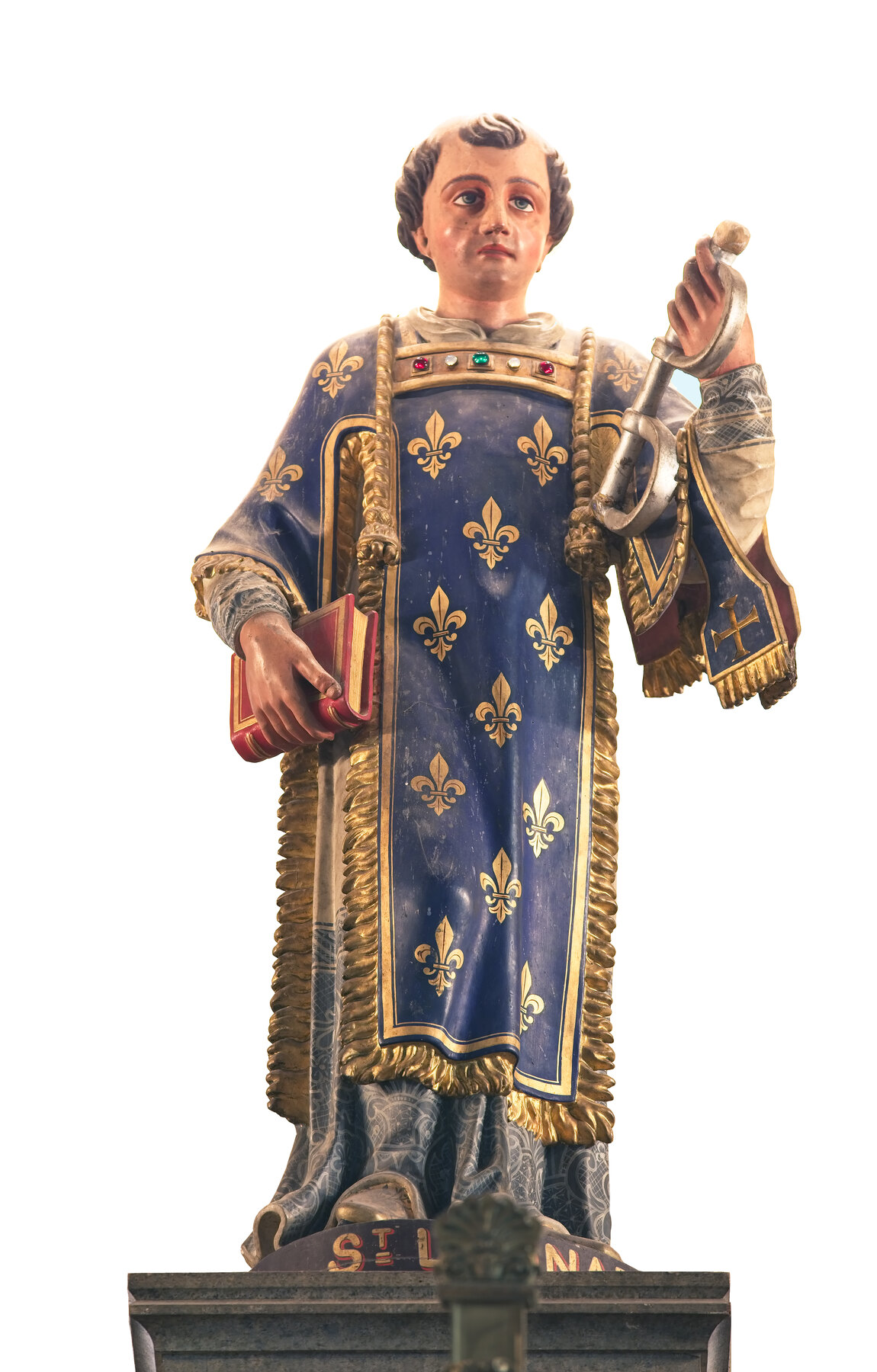
In the 6th century, Leonard declined the honours offered by King Clovis’s court. He asked for just one favour: to be allowed to free prisoners whom he deemed worthy of release. He settled as a hermit in a forest in Limousin, France, provided land for those he had freed, and helped them to rebuild their lives.
From this gesture, two words remain with us: liberty, fraternity.
This charism has travelled far and wide, and everywhere it has been expressed in the local language. In Bavaria, Saint Leonard became the patron saint of farm animals — those that wear irons, just as prisoners wore chains. In Zoutleeuw, miners invoke him so as not to remain trapped underground. Elsewhere, women in labour pray to him, because he had helped a Frankish queen to give birth to her child.
Everywhere, the same idea, in different guises: to break free from what holds us back.
Fifteen centuries later, his values are still very much alive.
For example, in Nice, the Trait d’Union charity provides accommodation for people leaving prison and operates under his patronage. Near Paris, the Mur’Mures charity helps young people to avoid falling into a life of crime and to get back on the right track.
No chain is permanent.
He brings us together
His story was written around 1025, at the request of Jourdain de Laron, Bishop of Limoges. It then travelled with the Benedictine and Cistercian monks, with the Normans of William the Conqueror as far as England, and with Bohemond of Antioch and the Hautevilles as far as southern Italy. Wherever it went, churches were named after him.
There are now more than 1,200. Bavaria and Italy have the most. But the density is surprising elsewhere: Slovenia, a small country, is home to sixty-one St Leonard’s churches all on its own. They can be found in Austria, England, Spain, Poland, the Czech Republic, Croatia, Malta, Portugal, Switzerland and Belgium — and as far afield as the Americas, Africa (Burkina Faso, Democratic Republic of the Congo) and even Oceania (Australia and New Zealand).
And people continue to gather there, in some cases for nearly a thousand years.
In Bavaria (Germany), horses and carriages are blessed during the Leonhardiritt, the grand horse parades that have been held in Bad Tölz since 1772 and still shape the life of entire villages. Inchenhofen, Germany’s most important place of pilgrimage, was the very first pilgrimage site visited by the Saint-Léonard de Noblat brotherhood in 1985.
In Flanders (Belgium), Saint Leonard has been carried in procession every Whit Monday since 1274 in Zoutleeuw and since 1495 in Sint Lenaarts — two traditions listed as part of Flanders’ intangible cultural heritage.
In Limousin (France), the Ostensions bring pilgrims together every seven years and have been listed as part of UNESCO’s Intangible Cultural Heritage since 2013.
None of this is set in stone.
In Kirkop, Malta, the Saint Leonard Band Club has opened new premises after fifteen years of hard work. In Sicily, religious brotherhoods are restoring statues and embroideries, and one parish has staged a play about the arrival of the cult in their community. In Lenart, Slovenia, the arrival of the relics brought together twelve parishes and made the headlines on regional television. In Lenartov, Slovakia, a bridge now bears the name Saint-Léonard-de-Noblat.
Places dedicated to Saint Leonard “of Noblat” in Europe
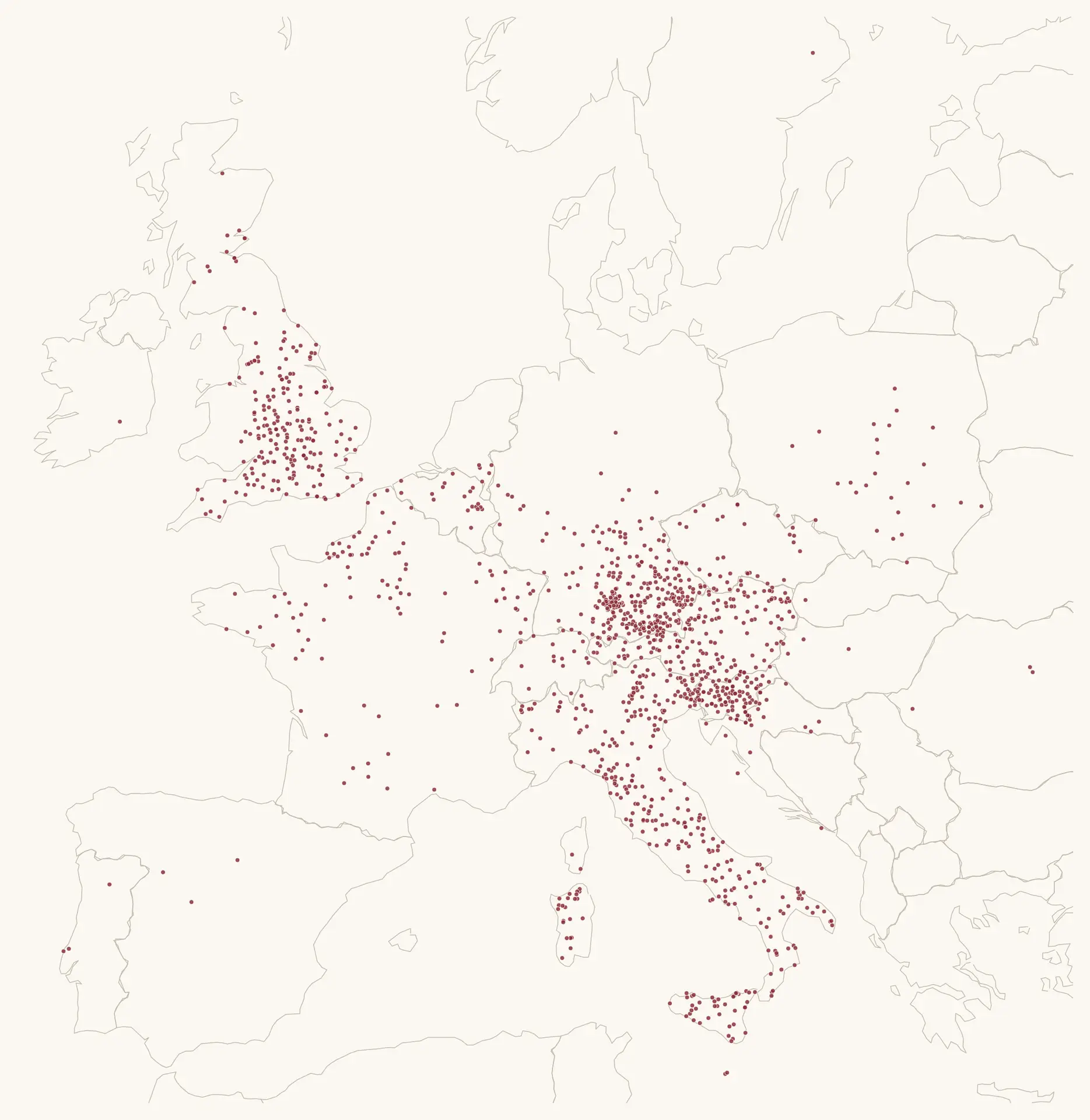
European sites recorded to date. The fil-leo inventory, September 2026 — building on the inventories compiled by Abbé Biossac in the 1960s and that by Connaissance et Sauvegarde de Saint-Léonard for the 1994 exhibition ‘Saint Léonard and the Roads of Europe, 11th–18th centuries’.
More than 1,200 active sites, and more than 150 traces or ruins. The survey is ongoing and is revealing new sites as it progresses. There’s bound to be one near you. Perhaps one we don’t know about yet.
fil-leo
These links had existed for a long time, but each had been operating independently. On 7 May 2016, at Saint-Léonard de Noblat, on the fringes of the Ostensions, delegations from across Europe came together in a constituent assembly to lay the foundation stone for fil-leo.
Our aim can be summarised in three points: to bring together the local authorities, parishes, brotherhoods and associations dedicated to Saint Leonard; to strengthen the links between these places; and to promote international recognition of his legacy.
Ten years on, the federation brings together more than 900 correspondents in around thirty countries, and the survey it launched has already identified more than 1,200 active sites. A quarterly newsletter in six languages. Visits, Erasmus+ school exchanges, and songs passed on from one country to another.
Join us
Subscribe to our quarterly newsletter: it’s free, published four times a year, and in your language.
Do you know of a church, chapel or brotherhood dedicated to Saint Leonard that isn’t shown on our map?
Please write to us at: fil-leo@federationstleonard.com
The latest issues of our newsletter
No. 27 — March 2026 · No. 28 — June 2026 · No. 29 — September 2026 (PDF)
All issues since 2017 will be available shortly.
fil-leo — 3 place Gay-Lussac, 87400 Saint-Léonard de Noblat, France
fil-leo@federationstleonard.com
ISSN 3074-1262